Saturday, September 19, 2026

Judgment Day is here - diesel prices soar

 Read: https://sonar21.com/judgment-day-for-the-middle-of-the-barrel-karl-millers-warning-that-diesel-has-stopped-meeting-demand/

Karl Miller’s latest private assessment, dated September 16 and titled “Judgment Day Has Arrived,” makes a single governing claim about diesel, jet fuel, and kerosene: physical demand is now outrunning promptly deliverable supply. Not the price of the barrel — the delivery of it. In Miller’s framing the market has crossed from a pricing problem, which money solves, to a deliverability problem, which money alone does not. The next phase, he argues, forces buyers to compete not just for fuel but for delivery capacity and for the cash to fund both at once.

I asked my expert, ChatGPT, about this.

Diesel supplies are running low, and in many places diesel prices are over $6 per gallon or not available. The problem will probably get worse before it gets better. What would happen to the US economy if diesel prices go above an average of $8 per gallon and remain there for the next year?

Yes. If the national average diesel price rose above $8/gallon and stayed there for a full year, I would expect a substantial negative shock to the U.S. economy—probably a combination of higher inflation and materially weaker economic growth. Whether it produced an outright recession would depend heavily on why diesel was $8 and whether actual shortages/rationing accompanied the price increase.

Your premise about current conditions is broadly correct. EIA reports that the national average reached $6.285/gallon on September 14, up from $5.26 only five weeks earlier. U.S. distillate inventories are about 13% below the five-year seasonal average, while U.S. refineries were operating at about 97% utilization, leaving relatively little easy capacity to increase production. EIA currently expects inventories to remain unusually low, although its baseline forecast does not anticipate $8 diesel for a year: it forecasts about $5.55 in Q4 2026 and $4.40 in 2027.

What $8 diesel would do

The important thing about diesel is that it isn't primarily a consumer fuel. It is an input into producing and transporting almost everything else. Trucks, agricultural machinery, construction equipment, mining equipment, some rail operations, generators, and parts of industry depend on diesel. EIA specifically notes that higher diesel prices raise road and rail freight costs and affect agriculture and heating oil.

Suppose diesel otherwise would have averaged roughly $4–$5. At $8, fuel expenses for a long-haul truck could approximately double. A tractor-trailer getting 6.5 mpg would have these fuel costs:

DieselFuel cost per mile
$4$0.62
$5$0.77
$6$0.92
$8$1.23

For a truck traveling 100,000 miles annually, moving from $5 to $8 adds about $46,000 per year in fuel expense.

Trucking companies cannot absorb anything close to that indefinitely. They would impose fuel surcharges and increase freight rates. Those costs would eventually work their way through Walmart, grocery stores, Amazon deliveries, construction materials, auto parts—essentially the entire physical-goods economy.

The biggest effects I'd expect

1. Another serious inflation impulse. Food would be particularly exposed because diesel appears repeatedly in its production chain: tractors and combines → trucks carrying crops → food processors → refrigerated trucks → supermarkets. Construction materials and manufactured goods would also become more expensive. This is exactly why the present diesel spike is already attracting inflation concerns.

I wouldn't assume that $8 diesel means CPI inflation rises by some mechanically fixed amount—the pass-through depends on margins, demand and monetary conditions—but sustained $8 diesel would make returning inflation to 2% considerably harder.

2. Trucking would undergo a shakeout. Large fleets usually have fuel-surcharge arrangements and hedging opportunities. Small owner-operators are much more vulnerable. Some would park trucks because certain loads would simply cease being profitable.

That creates a second-order problem: fewer available trucks → higher freight rates → higher product prices → reduced demand.

3. Agriculture would get hit unusually hard. Farmers use substantial quantities of diesel directly, particularly during planting and harvest. Diesel also affects fertilizer, trucking and other agricultural inputs. Some farmers could absorb one bad season; sustained prices for several seasons would increasingly change planting decisions and margins.

4. Construction would slow. Excavators, loaders, bulldozers, cranes and trucks consume enormous quantities of diesel. Contractors would increase bids, projects would become less economical, and some marginal projects would be postponed. That would affect both housing and commercial construction.

5. Consumers would get squeezed even if they don't own diesel vehicles. This is an important distinction from a gasoline shock. A person driving an EV doesn't escape an $8 diesel economy. They still buy food delivered by trucks, live in buildings constructed with diesel machinery, and purchase products transported through diesel-dependent supply chains.

6. The Federal Reserve would face an unpleasant dilemma. The initial shock would be supply-driven rather than excessive consumer demand. Raising interest rates doesn't manufacture diesel. But if fuel costs began feeding into wages, services and inflation expectations, the Fed could feel compelled to maintain tighter monetary policy even as economic growth weakened.

That is the classic recipe for stagflation: weak growth combined with persistent inflation.

The really dangerous scenario isn't $8 diesel—it's unavailable diesel

This distinction matters enormously.

If diesel were $8 but reliably available, the economy would adapt. Freight rates would rise, companies would consolidate shipments, rail would become relatively more attractive, inefficient trucking operations would close, consumers would reduce purchases, and eventually demand destruction would help bring prices down.

If diesel were $8 and frequently unavailable, the economic consequences would be considerably worse.

A trucking company can calculate a fuel surcharge for $8 diesel. It can't operate a truck without diesel.

Actual regional shortages could therefore produce temporary disruptions in food distribution, agriculture, construction, mining and manufacturing. That's when the situation begins looking less like ordinary inflation and more like a supply-chain crisis.

There is an important self-correcting mechanism

I would be skeptical that the United States could maintain an $8 average for an entire year without enormous behavioral and market responses.

At $8, refiners would have an extraordinary incentive to maximize distillate production; imports would become more attractive; exports could decline; businesses would conserve fuel; trucking demand would fall; consumers would buy fewer transported goods; and weaker economic activity itself would reduce diesel consumption.

We're already seeing the first part of that process. U.S. refiners are operating near practical capacity, and current diesel refining margins are extremely high.

That's why EIA's current forecast assumes today's extraordinary conditions eventually ease rather than projecting today's price increases indefinitely.

My rough economic scenario

If you specifically imposed the hypothetical "$8 national average from roughly late 2026 through late 2027", I'd think about the consequences approximately like this:

$8 but plentiful: severe cost shock → noticeably higher goods/food inflation → weaker consumer spending → trucking/agriculture/construction stress → substantially slower GDP growth and elevated recession risk.

$8 plus intermittent regional shortages: all of the above + supply-chain disruptions → substantially greater recession risk.

$8 plus persistent nationwide physical shortages/rationing: potentially a very serious recession, because the constraint would no longer simply be price. Businesses could literally be unable to move goods.

One other reason I'm concerned about the current situation is that it isn't primarily that America has run out of crude oil. EIA says U.S. distillate production this year has actually been the highest since 2019, while refineries are running near maximum utilization. The problem is unusually tight global refined-product supply, strong export demand and depleted domestic inventories. That makes this somewhat harder to fix quickly than simply increasing crude production.

So I think $8 diesel for a few weeks would be painful; $8 for twelve months would be a genuine macroeconomic event. And if the reason it remained at $8 was continuing physical scarcity rather than merely expensive crude oil, I'd be considerably more worried about the shortage than about the $8 number itself.

Saturday, September 12, 2026

Michael Hudson on Debt Restructuring

 Can you look at this transcript of an interview with Michael Hudson: https://www.unz.com/mhudson/the-long-trajectory-of-debt-dynamics-aristocracies-war-finance-and-wealth-destruction/ . I enjoy reading his ideas but he is so long winded. Can you summarize what is saying?

Yes. I read the transcript. It is about 6,700 words, but Hudson really has one central argument, with several historical illustrations.

Hudson's argument in plain English

Debt naturally tends to grow faster than the economy's ability to pay it. If society doesn't periodically restrain, restructure, or cancel excessive debt, creditors eventually acquire an increasing share of the property and income of everyone else. That produces an oligarchy, economic stagnation, and ultimately political instability.

Hudson thinks that this is not merely something happening today. He believes it is a recurring pattern stretching back thousands of years.

Here is the argument stripped down to its essentials:

  1. Ancient societies understood the debt problem better than we do. In Mesopotamia and some other ancient Near Eastern societies, rulers periodically canceled certain personal and agricultural debts, freed debt servants, and restored land that distressed farmers had pledged to creditors. Hudson connects this with the biblical Jubilee tradition. The purpose wasn't charity; rulers needed a viable population of farmers, taxpayers, soldiers and workers.
  2. Greece and Rome went in the opposite direction. They lacked a powerful central authority capable of regularly overriding creditors. Landowners and creditors accumulated political power, indebted farmers lost property, and society became increasingly polarized between wealthy creditors/landowners and everyone else. Hudson sees the decline of Rome partly through this lens.
  3. This is the basic choice throughout history: either government restrains creditors, or creditors eventually gain enough wealth to control government. Hudson therefore doesn't view "democracy versus autocracy" as the most important distinction. For him the important question is: Who controls credit and government—the financial/rentier class, or a government capable of subordinating finance to the productive economy?
  4. Modern Western capitalism initially recognized the problem. Hudson argues that Adam Smith, John Stuart Mill, Marx and other classical economists wanted capitalism to eliminate the remnants of feudalism—landlord rents, monopoly rents and unproductive financial claims. Banks ideally would finance factories, machinery, infrastructure and productive investment.
  5. Instead, capitalism evolved into "finance capitalism." Hudson thinks banks increasingly lend money primarily to purchase existing assets—houses, commercial real estate, stocks and companies—rather than to create new productive capacity. More credit therefore raises asset prices, which permits still more borrowing against those assets.

That's one of Hudson's most important ideas.

Imagine a house originally costs $200,000. Banks make more mortgage credit available, so buyers can bid $400,000. Society hasn't gained another house. Instead, the same house now carries twice as much debt.

The owner appears wealthier because the house is worth $400,000. The bank has a larger interest-bearing asset. But the next buyer has to devote much more of his income to mortgage payments.

Hudson calls much of this apparent increase in wealth financialization rather than productive wealth creation.

Where war enters the story

The middle section takes a rather unusual historical detour through medieval Europe.

Hudson argues that modern international banking developed largely because governments needed enormous amounts of money to fight wars. He places considerable emphasis on the medieval papacy, Italian bankers, the Crusades and later European monarchies. Kings borrowed to finance wars; bankers needed reliable repayment; governments consequently developed stronger systems of taxation.

Eventually city-states such as Florence and later the Dutch Republic became particularly creditworthy because they could pledge the taxing capacity of the whole population. Hudson sees this as an important step toward the modern "fiscal state": governments borrow enormous sums because creditors know governments can tax their populations to service the debt.

So Hudson sees an historical chain something like:

War → government borrowing → banking expansion → taxation to service debt → increasingly powerful financial institutions.

I would treat some of Hudson's specific claims about the medieval Church and Crusades more cautiously than his general economic argument; those are historical interpretations rather than uncontested facts.

What he thinks happened in the 20th century

World War I is a major turning point for Hudson.

He believes the Versailles reparations and inter-Allied debts demonstrated what happens when creditors insist that debts be paid regardless of whether the debtor economy can realistically generate the income necessary to pay them.

After World War II, Keynes wanted an international monetary system that would put pressure on both debtor and creditor countries to correct persistent imbalances. Hudson argues that the system that actually emerged—especially the IMF—became much more creditor-friendly. Countries in trouble were generally required to cut spending, privatize assets and impose austerity rather than force creditors to take losses.

Hudson thinks that same logic has now migrated from developing countries into the United States and Europe.

His diagnosis of America today

This is probably the part you're most interested in.

Hudson thinks Americans increasingly work not simply to consume goods and services, but to service layers of financial claims:

wages → taxes + mortgage/rent + credit cards + auto loans + student loans + health insurance + other debt service → what's left for ordinary consumption.

As debt service absorbs more household income, consumers have less money available to buy actual goods and services. Businesses therefore have less reason to expand productive capacity. Meanwhile, banks can make more money financing assets and financial transactions.

Thus, according to Hudson:

more debt → higher asset prices → greater wealth for asset owners → more interest/rent extraction → less disposable income → weaker consumer demand → less productive investment → deindustrialization.

And because the wealthy own most financial assets, the process also concentrates wealth.

Why Hudson is fascinated with China

This is where his politics sometimes confuses people. Hudson isn't simply saying "communism good, capitalism bad."

His argument is closer to:

China is doing something that Western industrial capitalism itself once intended to do: subordinate finance to industrial development.

He thinks China's major advantage is that the government retains much more control over banking and credit creation. Therefore it can direct credit toward infrastructure, factories, technology and industrial development instead of allowing private financial institutions primarily to inflate real estate and financial assets.

He also favors government provision or subsidization of infrastructure, transportation, communications, education and healthcare because that reduces the cost of employing workers. If a worker needs $80,000 to afford housing, healthcare, education and transportation, an employer ultimately has to generate enough revenue to support those costs. If those basic costs are lower, industry can operate more competitively.

That's actually a very old classical-economics argument, and Hudson deliberately frames it that way.

What does Hudson want us to do?

He never gives a neat ten-point program in this interview, but his prescription is pretty clear.

He wants debt write-downs when debts become economically unpayable; stronger public control over money and credit; taxation of land rents, monopoly rents and financial rents; public infrastructure; restrictions on monopolies; and a banking system oriented toward productive investment rather than asset-price inflation.

And he rejects the idea that every debt must always be paid in full.

His basic principle is essentially:

If paying the debt destroys the debtor's ability to produce, consume and invest, insisting upon full repayment ultimately hurts the creditor too.

Eventually either the debt gets written down deliberately, or the economic system writes it down involuntarily through defaults, bankruptcies, crashes and political upheaval.

The entire 6,700 words in one paragraph

Hudson believes Western economies have allowed finance to stop serving the productive economy and instead allowed the productive economy to become a vehicle for servicing debt. Ancient societies sometimes prevented this through debt cancellation; Greece and Rome didn't and became oligarchic; medieval war finance created powerful international banking systems; modern governments institutionalized creditor power; and today's enormous mortgage, corporate, consumer and government debts are increasingly extracting income instead of financing new production. Unless excessive debts are reduced and credit is redirected toward productive investment, Hudson expects Western economies to become increasingly unequal, indebted and deindustrialized. China, in his view, is outperforming the West partly because it has prevented private finance from gaining the same degree of control over credit and government policy.

One thing I find especially useful about Hudson is that you don't have to accept all of his political conclusions to find his distinction between productive credit and asset-price credit very insightful. A $10 million loan to build a factory and a $10 million loan to buy an existing $10 million building both create $10 million of bank debt, but economically they are quite different. The first can create additional productive capacity; the second primarily transfers ownership of an existing asset and may simply capitalize more debt into its price. That distinction is really at the heart of what Hudson has been arguing for decades.

Wednesday, September 2, 2026

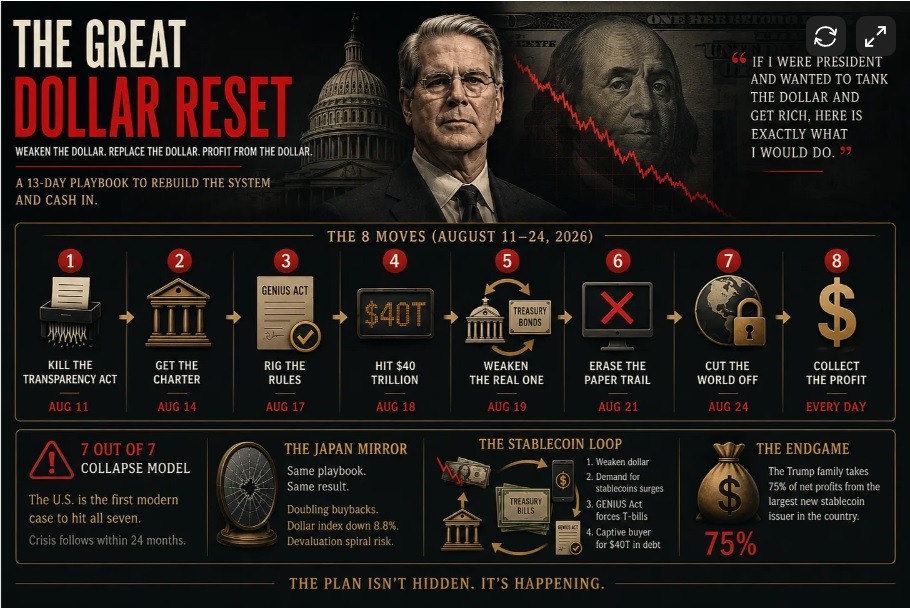
The Plan to Crash the Dollar and Profit from it


Source: https://healthimpactnews.com/wp-content/uploads/sites/2/2026/09/Treasury-Secretary-Scott-Bessent-Dollar-Reset.jpg

Read: https://substack.com/home/post/p-213623698

In my professional opinion, what I am looking at is the privatization of the American monetary system by three men [Bessent, Lutnick, and Trump]  who used government power to build it, government authority to legalize it, and government debt to fund it. And they did it in 18 months.