Saturday, May 21, 2016
Short-term interest rates are rising
Source: https://www.treasury.gov/resource-center/data-chart-center/interest-rates/Pages/TextView.aspx?data=yield
Short term interest rates are rising. Part of this is speculation that the FOMC will raise rates in June. Whatever the cause, it is a good sign.
When was the time it was this high? Specifically, when was the 1 month yield 0.26%? It looks like 2/17/09, more than 7 years ago.
Friday, May 20, 2016
Peak Debt and the Mother of All Financial Meltdowns
At Peak Debt, there is no capacity to absorb any more.
"That’s because at Peak Debt, the central bankers’ one-time parlor trick doesn’t work and actually backfires. Making credit artificially cheap previously induced households and business to tap their balance sheets and ratchet up their leverage ratios in order to supplement the natural sources of consumption and investment spending from wages and business cash flow, respectively, with the proceeds of incremental borrowings. But now cheap credit doesn’t even get to main street; it only induces more collateralized borrowing and speculation on Wall Street. Stated differently, when household and business balance sheets run out of capacity to absorb more debt, the repo man takes over."
Because our economy is run by crooks and fools, there is only one way this will end.
"To wit, what is coming down the pike is the Mother Of All Financial Meltdowns. And this time it will be evident to the world as to who is responsible for the resulting carnage."
http://davidstockmanscontracorner.com/the-inflation-targeting-scam-and-why-it-guarantees-the-mother-of-financial-meltdowns/
Main Street is at Peak Debt and so is the oil industry. Wall Street is getting close.
"That’s because at Peak Debt, the central bankers’ one-time parlor trick doesn’t work and actually backfires. Making credit artificially cheap previously induced households and business to tap their balance sheets and ratchet up their leverage ratios in order to supplement the natural sources of consumption and investment spending from wages and business cash flow, respectively, with the proceeds of incremental borrowings. But now cheap credit doesn’t even get to main street; it only induces more collateralized borrowing and speculation on Wall Street. Stated differently, when household and business balance sheets run out of capacity to absorb more debt, the repo man takes over."
Because our economy is run by crooks and fools, there is only one way this will end.
"To wit, what is coming down the pike is the Mother Of All Financial Meltdowns. And this time it will be evident to the world as to who is responsible for the resulting carnage."
http://davidstockmanscontracorner.com/the-inflation-targeting-scam-and-why-it-guarantees-the-mother-of-financial-meltdowns/
Main Street is at Peak Debt and so is the oil industry. Wall Street is getting close.
Wednesday, May 18, 2016
Sunday, May 15, 2016
Federal Reserve Bonds and Feudalism
The Federal Reserve balance sheet has about $4.5 trillion of assets, of which about $2.5 trillion is invested in U.S. treasury bonds, $1.7 trillion in mortgage backed securities, and $300 billion other factors. On the liability side, there is about $1.5 trillion in currency, $2.4 trillion in "Reserve Balances with Federal Reserve Banks" (also called "Excess Reserves"), and about $600 billion other factors.
The Excess Reserves are held by banks, mostly the big 6 - Bank of America, Chase, Citibank, Wells Fargo, Goldman Sachs and Morgan Stanley. (For the simplified example here, assume that they hold all the excess reserves). They receive interest on the excess reserves (IOER), which is currently set at 0.5%.
These $2.4 trillion in reserves are effectively bonds. The Fed uses the capital from the bonds to buy treasury debt. For simplicity sake assume these are all 10-year treasury bonds, which currently yields about 1.75%. The profit from the spread mostly goes back to the U.S. Treasury.
So what can we observe from this? The marginal rate that the U.S. government pays on debt is really 0.5% not 1.75%, because it gets a refund of the difference. So there is an incentive to incur more debt because the rate is so low. The banks are eager to lend because the 0.5% is risk-free - they are guaranteed to get it. It is guaranteed first by the Fed itself, second by the general credit of the U.S. treasury and by mortgages (Fannie Mae), and third by the taxpayers and mortgage holders of the U.S. The interest on $2.4 trillion at the rate of 0.5% is $12 billion per year. It doesn't sound like a lot, but consider that the $2.4 trillion was basically conjured up through thin air, while the $12 billion was earned through the blood, sweat and tears of millions of taxpayers.
I consider that someone who has an ultimate claim on every asset in a country, even though the percentage amount is very small, to be the sovereign. Especially since they can set the rate.
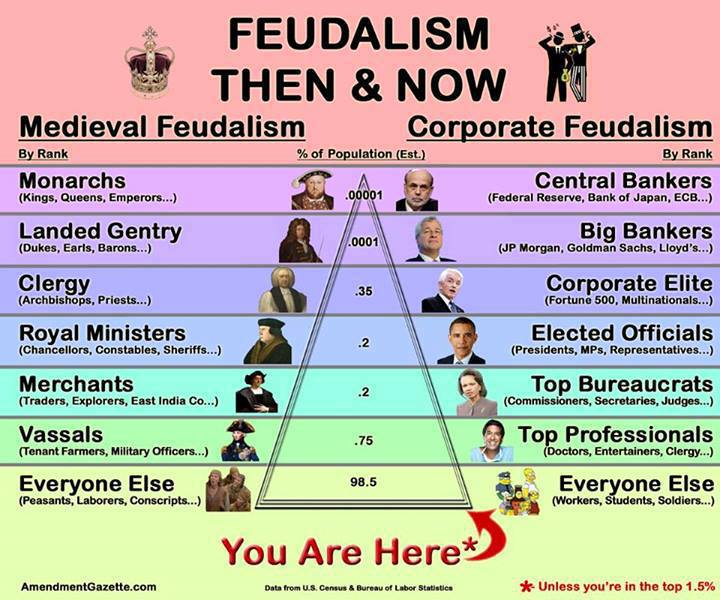
So what we have is feudalism - to a very minor degree. The queen is the chairwoman of the Federal Reserve, Janet Yellen. The dukes and lords are the presidents of the big banks and the directors of the Fed. The judges on the Supreme Court also are nobility, maybe call them "Law Lords". The President, really the Prince, owes fealty to the Queen of the Federal Reserve. In turn, every taxpayer in the US owes a good portion of their labor to the agents of the Prince (the IRS).
Interesting thought experiment.
Update - see this:
The Excess Reserves are held by banks, mostly the big 6 - Bank of America, Chase, Citibank, Wells Fargo, Goldman Sachs and Morgan Stanley. (For the simplified example here, assume that they hold all the excess reserves). They receive interest on the excess reserves (IOER), which is currently set at 0.5%.
These $2.4 trillion in reserves are effectively bonds. The Fed uses the capital from the bonds to buy treasury debt. For simplicity sake assume these are all 10-year treasury bonds, which currently yields about 1.75%. The profit from the spread mostly goes back to the U.S. Treasury.
So what can we observe from this? The marginal rate that the U.S. government pays on debt is really 0.5% not 1.75%, because it gets a refund of the difference. So there is an incentive to incur more debt because the rate is so low. The banks are eager to lend because the 0.5% is risk-free - they are guaranteed to get it. It is guaranteed first by the Fed itself, second by the general credit of the U.S. treasury and by mortgages (Fannie Mae), and third by the taxpayers and mortgage holders of the U.S. The interest on $2.4 trillion at the rate of 0.5% is $12 billion per year. It doesn't sound like a lot, but consider that the $2.4 trillion was basically conjured up through thin air, while the $12 billion was earned through the blood, sweat and tears of millions of taxpayers.
I consider that someone who has an ultimate claim on every asset in a country, even though the percentage amount is very small, to be the sovereign. Especially since they can set the rate.
So what we have is feudalism - to a very minor degree. The queen is the chairwoman of the Federal Reserve, Janet Yellen. The dukes and lords are the presidents of the big banks and the directors of the Fed. The judges on the Supreme Court also are nobility, maybe call them "Law Lords". The President, really the Prince, owes fealty to the Queen of the Federal Reserve. In turn, every taxpayer in the US owes a good portion of their labor to the agents of the Prince (the IRS).
Interesting thought experiment.
Update - see this:
Thursday, May 12, 2016
Tel Aviv Central Bus Station Dystopia
At 2.5 million square feet, the Tel Aviv Central Bus Station was the product of a grand vision to build an indoor micro-metropolis. Its expansive plans featured a shopping mall with thousands of stores, services and entertainment offerings. The structure even came to house a (now deserted) subterranean theater, originally meant to entertain people waiting for their bus. This vision gave way to a darker reality, resulting in what reporter Yochai Maital describes as “a derelict eight-story behemoth and modern day Tower of Babel, which mirrors much of modern Israeli history, with its grand vision and messy implementation.”
--http://99percentinvisible.org/episode/stop-that-bus/
Wednesday, May 11, 2016
Monday, May 9, 2016
Section 8 fail
Hillary’s rumored running mate, Housing Secretary Julian Castro, is cooking up a scheme to reallocate funding for Section 8 housing to punish suburbs for being too white and too wealthy. The scheme involves super-sizing vouchers to help urban poor afford higher rents in pricey areas, such as Westchester County, while assigning them government real estate agents called “mobility counselors” to secure housing in the exurbs. Castro plans to launch the Section 8 reboot this fall, even though a similar program tested a few years ago in Dallas has been blamed for shifting violent crime to affluent neighborhoods. http://nypost.com/2016/05/08/obamas-last-act-is-to-force-suburbs-to-be-less-white-and-less-wealthy/
You mean to tell me that moving hoodlums out of the ghetto into wealthy neighborhoods doesn't automatically make them upstanding citizens?
Sunday, May 8, 2016
Trump talks about defaulting on the national debt and freaks out the establishment
See: http://finance.yahoo.com/news/why-trumps-u-debt-default-222400110.html
and http://www.zerohedge.com/news/2016-05-06/trumps-election-should-cause-us-cds-spreads-spike-and-good-reason
The establishment sees the debt as being holy and it must never be questioned. It is supposedly the bedrock of global finance. The global economy will collapse if you even mention the possibility of default. I think it is a conversation we need to have and I am glad Trump brought it up.
and http://www.zerohedge.com/news/2016-05-06/trumps-election-should-cause-us-cds-spreads-spike-and-good-reason
The establishment sees the debt as being holy and it must never be questioned. It is supposedly the bedrock of global finance. The global economy will collapse if you even mention the possibility of default. I think it is a conversation we need to have and I am glad Trump brought it up.
Thursday, May 5, 2016
Truck Sales vs Recessions

Source: https://mishtalk.com/2016/05/05/class-8-truck-orders-plunge-39-large-truck-sales-vs-recessions/
A peak in heavy weight truck sales is a leading indicator of a recession. They typically peak about 1 to 2 years before a recession starts. It is difficult to tell from the above chart when the most recent peak was but it appears to be about January 2015. (Truck sales in January 2015 were almost 35,000 and they have never been this high since). If this is correct, then we can anticipate a recession to start later this year.
See also: http://www.wsj.com/articles/truck-orders-fall-in-april-1462383538
"Last month, trucking fleets ordered just 13,500 Class 8 trucks, the big rigs used on long-haul routes, down 16% from March and 39% from a year earlier. It was the fewest net orders in any April since 2009."
This is a stat that would be worth reviewing every month to see if the trend of lower heavy truck sales continues.
Monday, May 2, 2016
Status of Puerto Rico
Puerto Rico is an independent country within the empire of the United Status, as is the Northern Mariana Islands. The term of art used is "commonwealth". This is different from the status of Guam, and the US Virgin Islands and American Samoa, which are territories of the U.S., and the Federated States of Micronesia, which is a sovereign nation in free association with the United States.
Other entities with a similar status are Aruba, Curacao, and Sint Maarten, which are countries within the Kingdom of the Netherlands. Also, Jersey, Guernsey, and the Isle of Man, called "Crown Dependencies" (as opposed to British Overseas Territories), within the British Empire (as opposed to the British Commonwealth), and the Cook Islands and Niue in the Realm of New Zealand. And possibly Northern Cyprus within the Turkish Empire, (although no other country recognizes the independence of Northern Cyprus, instead seeing it as an occupied part of Cyprus). And also possibly New Caledonia, a "special collectivity" of France. And also Hong Kong and Macau with relation to China.
Puerto Rico is defaulting on its debts today. I think it is inevitable that Congress will pass a bailout bill of some kind, and I think the bailout will result in a loss of sovereignty of Puerto Rico, making it into more of a territory of the US.
Update: Upon further reading and reflection, I think that Puerto Rico is in fact already a territory of the US, and not independent. Read this:
"After the island was taken as a possession after the Spanish-American War, the Supreme Court decided in a series of “Insular Cases” that the totality of citizenship rights and state powers only applied to states and people living in so-called “incorporated territories,” which were retroactively defined as Alaska and Hawaii. Puerto Rico was left as an “unincorporated territory,” despite Congress establishing a formal independent government and constitution—actions which Puerto Rico’s highest court holds made it a de facto incorporated territory. That argument has gone unacknowledged by the Court, Congress, and the executive branch."
--http://www.theatlantic.com/politics/archive/2016/04/puerto-rico-debt-crisis-congress/480027/
Puerto Rico's highest court is the U.S. District Court for the District of Puerto Rico, from which decisions can be appealed to the First Circuit Court of Appeals in Boston, MA. If its highest court says that it is a de facto territory, and that decision hasn't been overturned, then I think it is pretty conclusive that it is a territory. The only thing that is independent about it is that it has a separate Olympics team.
I think the people of Puerto Rico should decide their status, but I guess they have already done that 4 times. I personally think they should either become a state or become totally independent. But that won't happen. Instead, Congress will bail them out and the dysfunctional status quo will prevail. This is a FAIL, with blame shared between Congress and Puerto Rico.
Other entities with a similar status are Aruba, Curacao, and Sint Maarten, which are countries within the Kingdom of the Netherlands. Also, Jersey, Guernsey, and the Isle of Man, called "Crown Dependencies" (as opposed to British Overseas Territories), within the British Empire (as opposed to the British Commonwealth), and the Cook Islands and Niue in the Realm of New Zealand. And possibly Northern Cyprus within the Turkish Empire, (although no other country recognizes the independence of Northern Cyprus, instead seeing it as an occupied part of Cyprus). And also possibly New Caledonia, a "special collectivity" of France. And also Hong Kong and Macau with relation to China.
Puerto Rico is defaulting on its debts today. I think it is inevitable that Congress will pass a bailout bill of some kind, and I think the bailout will result in a loss of sovereignty of Puerto Rico, making it into more of a territory of the US.
Update: Upon further reading and reflection, I think that Puerto Rico is in fact already a territory of the US, and not independent. Read this:
"After the island was taken as a possession after the Spanish-American War, the Supreme Court decided in a series of “Insular Cases” that the totality of citizenship rights and state powers only applied to states and people living in so-called “incorporated territories,” which were retroactively defined as Alaska and Hawaii. Puerto Rico was left as an “unincorporated territory,” despite Congress establishing a formal independent government and constitution—actions which Puerto Rico’s highest court holds made it a de facto incorporated territory. That argument has gone unacknowledged by the Court, Congress, and the executive branch."
--http://www.theatlantic.com/politics/archive/2016/04/puerto-rico-debt-crisis-congress/480027/
Puerto Rico's highest court is the U.S. District Court for the District of Puerto Rico, from which decisions can be appealed to the First Circuit Court of Appeals in Boston, MA. If its highest court says that it is a de facto territory, and that decision hasn't been overturned, then I think it is pretty conclusive that it is a territory. The only thing that is independent about it is that it has a separate Olympics team.
I think the people of Puerto Rico should decide their status, but I guess they have already done that 4 times. I personally think they should either become a state or become totally independent. But that won't happen. Instead, Congress will bail them out and the dysfunctional status quo will prevail. This is a FAIL, with blame shared between Congress and Puerto Rico.
Sunday, May 1, 2016
Friday, April 29, 2016
A fake war on space aliens is what we need
Ok, this is really old, but I don't think I have posted it before. Krugman thinks that if we thought space aliens were attacking and we spent a lot of money to defend ourselves, that would fix the economy. And then we discover it was all a mistake, but at least the economy is fixed.
The Insanity of Helicopter Money
"Among the most prominent advocates of MFFP is Adair Turner, whose latest book,“Between Debt and the Devil,” provides an insightful thought experiment on the use of helicopter money. Turner and his fellow MFFP advocates seem to believe that placing more money in the hands of the public is practically always welcome. In their view, it is not only a straightforward way instantly to boost real demand; it also seems preferable to debt-financed fiscal stimulus, owing both to political constraints on debt-burdened governments and to MFFP’s more direct — and thus faster — impact on economy-wide spending." --http://www.marketwatch.com/story/why-japan-is-resisting-the-false-allure-of-helicopter-money-2016-04-29
Umm, the author either hasn't thought this through or is an idiot (or maybe it is me who is misunderstanding something). We are comparing and contrasting two different things - "helicopter money" / MFPP ("money-financed fiscal program") vs "government investment" / DFFS ("debt-financed fiscal stimulus"). I will use the acronyms because it sounds more erudite.
I will start with the second option, DFFS. In this option, the Keynesian economists call for more spending, like a bridge to nowhere, or a war against space aliens or paying one person to dig a hole and another person to fill it back in, or increases to welfare, etc. So Congress will vote on some spending program, it doesn't matter what, and increase the deficit. It raises the money through selling bonds, which have pretty low rates right now. The money will go to some consumer, who will hopefully spend it and it will ripple through the economy, raising the GDP at least temporarily. And the Fed can optionally engage in QE and buy up the newly issued bond and increase the money supply. Keep in mind this is the sane option.
The first option is MFPP. Remember that the Central Bank's balance sheet must always be balanced. Printing money causes an increase in liabilities. If you just give it away, there is no increase in assets. So you just made your Central Bank insolvent. But, you say, we can always print more money. Yes and that causes "quasi-fiscal deficits". And that is when bad things really start to happen (hyperinflation). Once the Central Bank's balance sheet is thrown out of balance, it is almost impossible to get back into balance. (I guess the government could bail it out, but that would be a hard sell, asking taxpayers to bail-out the banks). And once it is out of balance, why not keep going? It's so fun being Santa Claus, err, giving money to your politically connected buddies. Next thing you know, Zimbabwe.
So no, we don't want "helicopter money" at least the MFPP kind. Let's just stick to straight DFFS, which is crazy enough. Crazy is enough, we don't need batshit psycho insanity.
People in Phoenix rent converted shipping containers for $1,000 per month
PHOENIX -- A stack of shipping containers sitting in a lot in an industrial section of Phoenix has some developers thinking inside the box.
The structures usually used to transport cargo have been transformed into eight apartments. Scuff marks, old serial numbers and shipping company logos remain, but a look inside each unit reveals a 740-square-foot modern home.
"It doesn't even feel like a shipping container. It's also insulated really well," said Patrick Tupas, who is in the Air Force and along with his wife signed a one-year lease for $1,000 a month. "It just feels like a regular apartment."
Thursday, April 28, 2016
Microsoft to use DNA as long-term storage
'As our digital data continues to expand exponentially, we need new methods for long-term, secure data storage,' explained Doug Carmean, a partner architect within Microsoft's Technology and Research organisation.
Researchers will transfer the 1s and 0s of binary code into the four bases of DNA - A, C, T and G - transferring the data from the digital to the biological.
Microsoft and University of Washington researchers will work to translate a volume of binary code to a corresponding DNA, with Twist Bioscience then making strands of synthetic DNA according to the sequences.
'They give us the DNA sequence, we make the DNA from scratch,' Dr Emily Leproust, CEO of Twist Bioscience, told IEEE Spectrum.
Last year, researchers in Slovenia conducted a proof of concept study, to store data in the DNA of a plant. They transferred the '1's and '0's of binary into the four bases of DNA: A, G, T and C.
A was 00; C was 10; G was 01; and T was 11.
Wednesday, April 27, 2016
Central Bank Assets
This is an interesting article about the liquidity of the Swiss National Bank: https://snbchf.com/snb/marc-meyer/central-bank-independence-farce/. Most of the assets of the SNB are holdings of foreign currency, either US dollars or Euros. If dollars or euros go done in value against the Swiss franc, then the SNB loses money.
And it has lost money, boatloads. "Throughout the past decades, our National Bank has invested in foreign currencies. The accumulated foreign exchange losses of the SNB have approximately reached into the three-digit billions – at the expense of Switzerland."
If the franc keeps going up against dollars and euros, then the SNB could become technically insolvent, with liabilities exceeding assets. How could it get out of this mess? By printing more francs and buying euros and dollars with them. This would cause the value of the franc to drop and the value of euros and dollars to rise, thus creating foreign exchange gains, but causing inflation internally.
So the SNB has a vested interest in keeping the euro and dollar strong.
=====================================================
Now, contrast this with the Federal Reserve. Its assets are mostly US Treasury Bonds and Fannie Mae and Freddie Mac bonds. If interest rates rise, then the value of its assets will drop, and if they drop enough, the Fed could become technically insolvent. It would fix it primarily by suspending payments of interest to the Treasury. But it may need to do more than this, by printing more dollars to buy more Treasury bonds, which could cause the value of the bonds and Fed assets to rise and interest rates to drop (QE), thus weakening its liabilities (FRNs) against its assets.
=====================================================
To take this a step further, what would happen if both of these occurred at the same time? The SNB would be printing more francs to buy dollars (to try to strengthen the dollar) and the Fed would be printing more dollars to try to weaken the dollar. The net effect is that the SNB is indirectly purchasing Treasury bonds.
So just a thought, why doesn't the SNB buy US Treasury bonds directly (maybe it already is, I don't know). Except then it would face losses if interest rates rise. And another thought that the SNB is enabling more US debt. And a final thought, why did the SNB sell off most of their gold? It sure seems like a safer long-term investment than the ever-increasing U.S. debt.
And it has lost money, boatloads. "Throughout the past decades, our National Bank has invested in foreign currencies. The accumulated foreign exchange losses of the SNB have approximately reached into the three-digit billions – at the expense of Switzerland."
If the franc keeps going up against dollars and euros, then the SNB could become technically insolvent, with liabilities exceeding assets. How could it get out of this mess? By printing more francs and buying euros and dollars with them. This would cause the value of the franc to drop and the value of euros and dollars to rise, thus creating foreign exchange gains, but causing inflation internally.
So the SNB has a vested interest in keeping the euro and dollar strong.
=====================================================
Now, contrast this with the Federal Reserve. Its assets are mostly US Treasury Bonds and Fannie Mae and Freddie Mac bonds. If interest rates rise, then the value of its assets will drop, and if they drop enough, the Fed could become technically insolvent. It would fix it primarily by suspending payments of interest to the Treasury. But it may need to do more than this, by printing more dollars to buy more Treasury bonds, which could cause the value of the bonds and Fed assets to rise and interest rates to drop (QE), thus weakening its liabilities (FRNs) against its assets.
=====================================================
To take this a step further, what would happen if both of these occurred at the same time? The SNB would be printing more francs to buy dollars (to try to strengthen the dollar) and the Fed would be printing more dollars to try to weaken the dollar. The net effect is that the SNB is indirectly purchasing Treasury bonds.
So just a thought, why doesn't the SNB buy US Treasury bonds directly (maybe it already is, I don't know). Except then it would face losses if interest rates rise. And another thought that the SNB is enabling more US debt. And a final thought, why did the SNB sell off most of their gold? It sure seems like a safer long-term investment than the ever-increasing U.S. debt.
Subscribe to:
Posts (Atom)