Saturday, November 27, 2010

Saturday, November 13, 2010
Japan will default in 2012
According to Kyle Bass, (see also this) this will occur within 1-2 years, so I will call it 2012. Japan has already entered the Keynesian endpoint: their debt service costs exceed their income. They are already more than 1 quadrillion yen in debt and the revenue is only 40 trillion yen, with expenses at 97 trillion. Their national savings rate is now zero percent. Their system has been like a Ponzi scheme that works as long as there are new buyers. Well now there are no new buyers as their demographics have changed.
The only good news about this is that Japan has been relatively isolated from the rest of the world so the default won't cause a chain reaction. And maybe it will cause the US to wake up and realize how severe our problems are.
Another Debt Projection
9/30/2008 10025
9/30/2009 11910
9/30/2010 13561
9/30/2011 15528
9/30/2012 17780
9/30/2013 20358
9/30/2014 23310
9/30/2015 26689
9/30/2016 30559
9/30/2017 34990
9/30/2018 40064
9/30/2019 45873
9/30/2020 52525
9/30/2021 60141
9/30/2022 68861
9/30/2023 78847
9/30/2024 90279
9/30/2025 103370
So what does this mean? At some point relatively soon, the whole system will skyrocket out of control. What is my best guess for when this will happen? Well, if my theory about 10 times revenue being the breaking point is correct, I see this happening sometime in 2017. Revenue in FY 2017 is projected at $3.477 trillion, with national debt at $34.990 trillion.
I've been wrong before and I hope I am wrong here, but this is scary. When I first started this blog, I was projected the endpoint as being in 2022, thus the name of the blog. Then I bumped it to 2028, then I lowered it to 2025. Now I think the end will occur much sooner. Maybe I am being paranoid, but check out the slope on this graph from official federal reserve data:
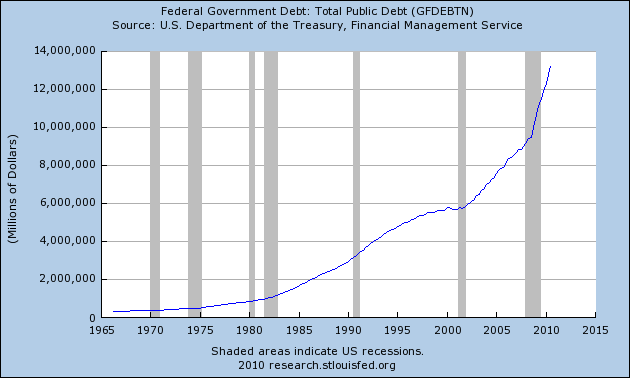
Update 6/19/2012: This is model D-1 and is discredited, because the debt isn't increasing that fast.
Saturday, November 6, 2010
Bankruptcy of the US is a mathematical certainty
“If you run the numbers, on all those numbers that you just talked about, which I think are accurate, very accurate, in 20 or 25 years, the United States goes bankrupt,” said Allison. “It’s a mathematical certainty. ... “Now, countries don’t go bankrupt the way companies do,” said Allison. “They don’t file bankruptcy. They usually hyper-inflate.
--http://www.cnsnews.com/news/article/former-bbt-ceo-bankruptcy-us-mathematica
Friday, November 5, 2010
2010 Final Numbers
| 2008 | 2009 | 2010 | My 2011 Estimate | My 2012 Estimate | |
| Receipts | 2524 | 2104 | 2162 | 2460 | 2728 |
| Outlays | 2983 | 3520 | 3456 | 3801 | 3832 |
| Deficit | -459 | -1416 | -1294 | -1341 | -1104 |
Sunday, October 31, 2010
Friday, October 29, 2010
Hyperinflation by 2012?
Therefore, I am confident in predicting the following sequence of events:
• By March of 2011, once higher commodity prices reach the marketplace, monthly CPI will be at an annualized rate of not less than 5%.
• By July of 2011, annualized CPI will be no less than 8% annualized.
• By October of 2011, annualized CPI will have crossed 10%.
• By March of 2012, annualized CPI will cross the hyperinflationary tipping point of 15%.
After that, CPI will rapidly increase, much like it did in 1980.
--http://gonzalolira.blogspot.com/2010/10/signs-hyperinflation-is-arriving.html
I think he is spot on. This isn't going to directly cause the debt collapse that I have been warning about in the blog - countries can survive for years with hyperinflation - but it will make life very different. I think a temporary solution would be to use some other currency for savings and for day to day purchases, maybe the Canadian dollar.
Sunday, October 24, 2010
Sunday, October 10, 2010
Massive inflation coming?
It isn't going to work. While the sentiment may be good, it doesn't justify the actions taken. Is stealing ok if I give the money to a homeless shelter? No. The flood of cheap money will go into the pockets of just a few well-connected people who will just dump it in the stock market and won't buy real estate. It won't help the homeless and jobless at all.
And it will cause a little inflation, but will increase the deficit even more because of the automatic cost-of-living increases and higher interest rates and higher oil prices. And once inflation starts, it takes on a life of its own.
While this action alone won't cause the type of collapse that I have been warning about on this blog, I think it will speed up the process.
Wednesday, October 6, 2010
US Debt increased 65% in just 2 years!
On 9/30/2010, the US debt held by the public was $9,023 billion.
That's an increase of 65%!
Does anybody see a problem?
Tuesday, October 5, 2010
How long does it take to spend $500 billion?
This is actually an improvement, since the last time I asked a similar question, I determined that it took only 6 months to spend 1 trillion dollars.
Sunday, September 26, 2010
The next crisis is coming
After what happened since October 2008, I mean, elementally, you would think what? That now they’re going to change. I mean, they see that the model is not working. The model is even poisonous, you know? Dramatically poisonous. And what is the result, and what happened in the last meeting of the European Union? They are more fundamentalist now than before. So, the only thing you know that you can be sure of, that the next crisis is coming, and it will be twice as much as this one. And for that one, there won’t be enough money anymore. So that will be it. And that is the consequence of systematical human stupidity.
--Manfield Max-Neef at http://www.democracynow.org/2010/9/22/chilean_economist_manfred_max_neef_us
Tuesday, September 21, 2010
Stock Market mini-crash about October 20?
October 29, 1929 great stock market crash
October 19, 1987 The stock market crashed for no apparent reason, and the Dow was down 22%.
October 13, 1989 ("Friday the 13th mini-crash") - The stock market drops 12% over 2 days, blaming a failed buyout. "Many investors were left stunned".
October 11, 1990 Dow Jones at 2365
September 10, 1998 - Dow hits a short term low of 7,615
September 23, 1998 - LTCM crash. LTCM was providing returns of 40% annually when suddenly their economic theories quit working. The Fed bailed them out, fearing a systemic collapse.
September 11, 2001 - The stock market closed for a week and when it opens, drops 14%.
September 21, 2001 - dow closes at 8,235
October 9, 2002, dow closed at 7,286, a 37.8% decline.
September 15, 2008 - Lehman Bros collapsed, the stock market quickly drops 5%, the Fed takes over AIG, and Congress rushes through a $700 billion bailout.
October 27, 2008 - Dow Jones hits a short-term low of 8,175. (It jumped by 900 points the next day, but dropped even further in Nov. 2008 and March 2009).
Update:
The Panic of 1873 started on September 18, 1873 with the failure of Jay Cook & Company. This started a chain reaction of bank failures and the NYSE closed for ten days starting Sept. 20, 1873.
The Panic of 1907 started on October 22, 1907 with a bank run on the Knickerbocker Trust Company.
Update 2:
Montgomery recalls living through the October "massacres" of 1978 and 1979, the crash of 1987, the mini-crash of 1989, the 1997 Asian collapse and the Long-Term Capital Markets plunges [in 1998], which started to cascade downward in late September. And while gold bullion topped in January 1980, gold stocks made their highs on Sept. 22 of that year, he adds. That date also saw the peak in many oil stocks.
Looking back farther, on Sept. 22, 1929, the Dow Jones Utility Index became the final major average to make its high before the Great Crash. And in 1873, a panic forced the New York Stock Exchange to shut down, Montgomery further details.
And who can forget 2008, when markets went into free fall in the days following the collapse of Lehman Brothers? What's remembered less well now is the market chaos in the subsequent days after the House of Representatives initially rejected legislation that created the Trouble Asset Relief Program
Currencies have seen historic changes around this date as well, he adds. The British pound was taken off the gold standard and was devalued a huge 28% on September 21, 1931. Exactly 54 years later, the Group of Five produced the Plaza Accord, which brought a sharp decline in the dollar and expansion of global liquidity. Black Wednesday, when Britain was forced to withdraw from the European Exchange Rate Mechanism, came a few days early on Sept. 16, 1992.
I also recollect that Treasury note and bond yields made their historic highs in late September, 1981, with shorter maturities hitting 17% and long bonds reaching 15%. That marked the end of a 35-year bear bond market from the end of World War II.
"If that's not enough, several of the astrological types claim their charts show [this] week is fertile ground for surprises – geo-political and otherwise."
http://www.zerohedge.com/news/2014-09-22/bofaml-repeats-art-cashins-concerns-september-seasonal-slump
Update 3: The Black Friday gold panic of September 24, 1869 was caused when two speculators attempted to corner the gold market. The price of gold briefly went as high as $162.50 per ounce before dropping to $133 after the Treasury sold some gold.
Monday, September 20, 2010
Hurrah the recession is over!
In determining that a trough occurred in June 2009, the committee did not conclude that economic conditions since that month have been favorable or that the economy has returned to operating at normal capacity. Rather, the committee determined only that the recession ended and a recovery began in that month. A recession is a period of falling economic activity spread across the economy, lasting more than a few months, normally visible in real GDP, real income, employment, industrial production, and wholesale-retail sales. The trough marks the end of the declining phase and the start of the rising phase of the business cycle. Economic activity is typically below normal in the early stages of an expansion, and it sometimes remains so well into the expansion.
The committee decided that any future downturn of the economy would be a new recession and not a continuation of the recession that began in December 2007.--http://www.nber.org/cycles/sept2010.html
Friday, September 17, 2010
CBO: Don't worry, be happy!
Don't worry, be happy!
Year 2038 bug
Starting at GMT 03:14:07, Tuesday, January 19, 2038, I fully expect to see lots of systems around the world breaking magnificently: satellites falling out of orbit, massive power outages (like the 2003 North American blackout), hospital life support system failures, phone system interruptions (including 911 emergency services), banking system crashes, etc. One second after this critical second, many of these systems will have wildly inaccurate date settings, producing all kinds of unpredictable consequences. In short, many of the dire predictions for the year 2000 are much more likely to actually occur in the year 2038!
--http://maul.deepsky.com/~merovech/2038.html
Monday, September 13, 2010
Is ten times revenue the debt limit?
The last hard numbers I have are for 9/30/09 when revenue was at 2105 and total debt was 11,910 for a Debt Crisis Number or "Crip" of 5.7. The number at 9/30/10 should be about 6.4, with revenue of 2,100 and debt of 13,500.
So the question is, when will this reach the max of 10? Well there are lots of assumptions, but my best guesstimate is in 2025, when tax revenues will be $5,346B and debt will be $58,332B.
Update 6/19/2012:
This is model C-1.
Counterpoint: why hyperinflation in the US is impossible
In essence, what he is saying is that hyperinflation is always a political event, not a financial event." The commonality between Zimbabwe and Weimar is they are both political events. In Zimbabwe a political event triggered capital flight, in Weimar a political event started massive printing, triggering hyperinflation."
He says that it is impossible for the Federal Reserve on its own to cause hyperinflation. Congress can cause hyperinflation through massive spending; however, they won't.
I disagree with his conclusion. I believe that at some point people will lose faith in the ability of the government to pay back the massive debt and that lack of faith and the reaction to it will cause hyperinflation.